
-
About Us
Why Choose Us?Haining Huayu Textile Co., Ltd., founded in 2020 in Haining, Zhejiang, is a professional sofa fabric manufacturer with a registered capital of RMB 5 million. Backed by strong production capabilities and a customer-first, credit-based philosophy, we offer a wide range of reliable products. We sincerely welcome global partners for win-win cooperation.
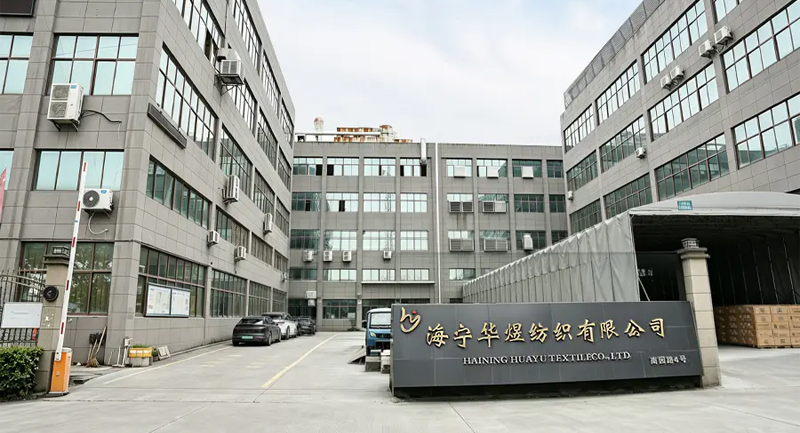 Coming From China, Marketing To The World.
 -
Products
- > Sofa Fabrics
- > Dutch Velvet Sofa Fabric
- > Lambswool Sofa Fabric
- > Frosted Fleece Sofa Fabric
- > Technical Sofa Fabric
- > Woven Sofa Fabric
- > Printed Sofa Fabric
- > Chenille Sofa Fabric
- > Finished Curtain
- > Double-layered Openwork Star Curtain
- > High-precision Solid Color Curtain
- > Double-layer High-precision Curtain
- > Hot-Stamped Printed Curtain
- > Sofa Cover
- > Milk Silk Sofa Cover
- > Cationic Sofa Cover
- > Circular Knit Jacquard Sofa Cover
- > Seersucker Sofa Cover
- > Sofa Throws
-
News
 English
Functional Finishing Technologies for Sofa Fabrics: Three-Proof, Flame Retardant, and Antibacterial
1. Technical Route of Three-Proof Finishing
Three-proof finishing (water-repellent, oil-repellent, and stain-repellent) is the most basic and widely used functional treatment in sofa fabric finishing. Traditional processes use fluorine-containing finishing agents, which form a low-surface-energy film on the fiber surface through padding-drying-curing. In recent years, non-fluorinated eco-friendly three-proof technology has become an important direction. For example, Teflon EcoElite™, the world's first plant-based stain-repellent finishing technology, uses a non-fluorinated formula with durability up to three times that of other non-fluorinated water-repellent finishes, effectively repelling both water-based and oil-based stains.
From a technical principle perspective, the effectiveness of three-proof finishing depends on the uniformity of the film formation on the fiber surface and the chemical bonding strength with the fiber. In the padding process, the finishing liquor concentration, wet pickup, and curing temperature are three key parameters. Insufficient curing temperature leads to incomplete film formation, while too high a temperature may damage the fiber hand feel. For polyester fabrics, the curing temperature is usually controlled in the range of 170–180°C.
2. Technical Paths and Standard Systems for Flame Retardant Finishing
The flame retardant performance of sofa fabrics is related to public safety. Its technical routes are mainly divided into two categories: additive flame retardancy and inherent flame retardancy.
Additive flame retardancy applies flame retardants to the fabric through finishing. Traditional processes use flame-retardant coating cold-press finishing technology, using polyester and cotton blended fabrics, with a flame-retardant coating formulation made from vinyl acetate-acrylate emulsion, eco-friendly antimony trioxide, hexabromocyclododecane, etc., applied to form a flame-retardant coating. Advanced padding flame-retardant finishing processes use soaping, drying, high-temperature setting (180°C, 30 m/min), and curing to form a flame-retardant chemical structure on the fabric surface, achieving permanent flame retardancy.
The inherent flame retardancy route solves the problem from the fiber source. Using pre-oxidized polyacrylonitrile fiber spun into flame-retardant yarn as the substrate, woven into greige fabric, and then finished with three-proof agents, it fundamentally avoids the adverse effects of flame-retardant finishing on fabric hand feel, successfully solving the technical problem that traditional flame retardants and three-proof agents are incompatible.
At the standard level, sofa fabric flame retardancy must meet the requirements of GB 17927-2011 "Evaluation of the Ignition Resistance of Upholstered Furniture - Mattresses and Sofas": no smoldering spread after 60 minutes of cigarette smoldering, and afterflame ≤10 seconds for open flame. Damage length must be ≤150mm (GB/T 5455), and limiting oxygen index ≥28% (ASTM D2863). For export to the EU market, it must also meet BS 5852 Source 0/1/5 (cigarette/match/wooden crib ignition sources) and BS EN 1021 Part 1&2. For the US market, it must pass CAL TB 117-2013 and NFPA 260 standards.
3. Technical Solutions for Antibacterial and Anti-Mite Finishing
Antibacterial and anti-mite functions have become important value-added directions for sofa fabrics, especially against the backdrop of the rise of "human-pet co-existence" household scenarios, where demand for fabrics with composite functions such as antibacterial, anti-mite, waterproof, stain-resistant, and scratch-resistant has surged.
Technical routes for antibacterial finishing include silver ion treatment, quaternary ammonium compounds, and photocatalytic antibacterial agents. Silver ions achieve broad-spectrum antibacterial activity by disrupting bacterial cell walls and inhibiting enzyme activity, with good durability, but attention must be paid to the migration of silver ions that may affect fabric color. Quaternary ammonium antibacterial agents have lower cost but limited wash durability. Photocatalytic antibacterial agents (such as nano-TiO₂) require light activation and are suitable for sofa scenarios near windows.
Integrating antibacterial function with three-proof function is a current technical challenge. The compatibility of antibacterial agents with three-proof finishing agents directly affects functional durability, requiring optimization of auxiliary formulations and finishing sequence. Some commercial products have achieved the integration of FibreGuard antibacterial and stain-resistant technology with anti-mildew functions, with antibacterial and stain-resistant finishing reducing bacterial transmission by up to 95%.
-
Soft Textured Dutch Velvet Sofa Fabric
This Dutch Velvet Sofa Fabric features a refined velvet surface with a soft, dense hand feel and a s...
-
Ribbed Plush Chenille Sofa Fabric
Ribbed plush texture brings this Chenille Sofa Fabric a clear linear surface with soft raised yarns....
-
Basket Weave Woven Sofa Fabric
Basket weave construction gives this Woven Sofa Fabric a clear interlaced texture, with visible yarn...
-
Raised Grid Woven Sofa Fabric
Defined by a raised grid weave, this Woven Sofa Fabric has a clear block-like texture that gives uph...
Copyright © Haining Huayu Textile Co., Ltd. All Rights Reserved.
